
NAC BlogTeaching & LearningOctober 30, 2026
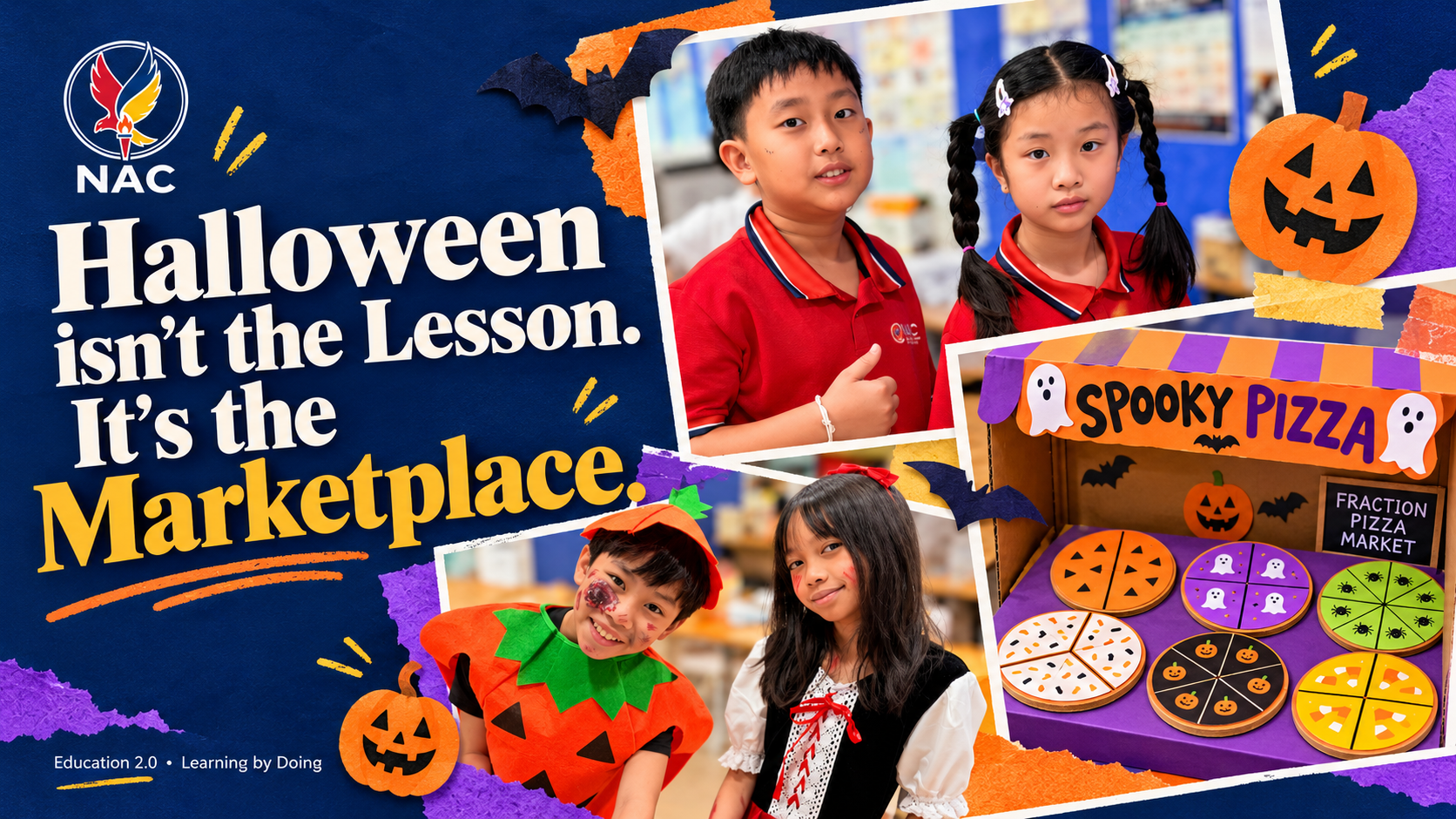
Halloween isn’t the lesson.It’s the marketplace.
How our Grade 5 and Grade 6 students are turning a holiday theme into real-world problem solving, one cardboard stall at a time.


Every October, classrooms around the world fill up with paper bats and pumpkin worksheets. Most of it is decoration: the same fraction drill as last week, now with a jack-o’-lantern printed in the corner. This year at NAC, we asked a different question. What if the theme were not the wrapping on the problem, but the place where the problem actually lives?
So on Friday, October 30, our Grade 5 and Grade 6 students walked into math class and were handed a business. Grade 5 opened The Halloween Fraction Market, a stall selling pretend spooky pizzas. Grade 6 opened The Halloween Percent Shop, complete with price tags, discounts, stock counts and a customer on a budget. Over the next week, working in pairs, they will build the stall, run the numbers, and on November 6 stand behind their counter and defend every calculation they made.
Decoration versus design
A themed worksheet asks a student to solve 214 + 123 next to a picture of a ghost. A themed problem gives them a reason to care about the answer. In the Fraction Market, that reason is obvious: a delivery of 2¼ pizzas arrived this morning, another 1⅔ came at noon, and you need to know exactly what is on your counter before the evening rush.
The math is identical. The reason for doing it is not.
That distinction sits at the heart of thematic learning done well. A theme earns its place in the classroom when it creates a situation with real stakes, real constraints and a real audience. Halloween happens to offer all three. Children genuinely care about it. It already comes with a marketplace attached, full of costumes, treats and decorations. And it ends in a celebration where work can be shown off to friends and families.

Two grades, two businesses
Both projects follow the same arc and share the same rules: pairs, a recycled box, everything made by hand, and a short presentation at the end. What changes is the mathematics each grade is ready to wrestle with.
Inside the Fraction Market
Grade 5 pairs write six short stories about their stall. Three are deliveries, which means addition. Three are sales, which means subtraction. Every calculation must use two mixed numbers with unlike denominators, and at least two of the subtractions must require regrouping. Each card follows the same path: story, equation, common denominator, working, and a simplified answer with units.
The rule that makes this feel real is also the simplest one on the brief: never sell more than you have. A child who has to check that a sale is possible before calculating it is thinking like a shopkeeper, and that is exactly the kind of judgment a worksheet never asks for.
Sales card: the evening rush
“We had 4⅓ pizzas left. A family bought 1¾. How much is still on the counter?”
- 413−134Check first: is 1¾ less than 4⅓? Yes, so the sale is possible.
- 4412−1912Common denominator of twelfths
- 31612−1912Not enough twelfths, so regroup one whole pizza into 12 slices
- 2712 pizzas left
Students then prove the same calculation twice more with their hands: once with the pizza slices themselves, and once with paper fraction strips that show why one third is the same as four twelfths. When a ten-year-old physically breaks a whole pizza into twelve slices to complete a subtraction, regrouping stops being a rule to memorize and becomes something they can see.


Inside the Percent Shop
Grade 6 runs a slightly more grown-up business. Each pair creates four pretend products, from ghost bookmarks to mini witch hats, and assigns each one a discount: 10%, 20%, 25% and 50%, each used exactly once. For every product they show the discount three ways, as a fraction, a decimal and a percent, then calculate the money saved and the new sale price.
Discount card: paper bats, 25% off
Original price ฿160
- 14=0.25=25%One discount, three representations
- ฿160×0.25=฿40 saved
- ฿160−฿40=฿120 sale price
Turning stock into a picture of percent
Next, each pair makes 20 paper stock counters spread across their four products, then records every product as a count, a fraction of 20, a decimal and a percent. On a 10 × 10 grid, they color five squares for every counter. The design is deliberate. Twenty counters times five squares fills all 100 squares, so the finished grid is a direct picture of the idea that 20 counters equal one whole, which equals 1.00, which equals 100%.
The customer challenge
Finally, a customer arrives with ฿250 and wants two different products at sale prices. Students compare two possible baskets on a handwritten budget card, show each total and the change, and then do the thing adults do every day at the market: recommend one and explain why.
Budget card: a customer with ฿250
- Basket A: ฿72 + ฿100 = ฿172Change: ฿250 − ฿172 = ฿78
- Basket B: ฿96 + ฿120 = ฿216Change: ฿250 − ฿216 = ฿34
- Recommend A: two products and ฿44 more change
There is no single correct basket. A strong answer is a well-reasoned one, and that is precisely the point. Real problems rarely come with one answer printed in the back of the book.


One week, start to finish
What we assess, and why
Both grades share the same success criteria. Correct mathematics carries the most weight, as it should. But notice that more than half of the grade rewards how students represent, explain and collaborate around that mathematics.
A student who gets the right answer but cannot show it with a model, or explain it to a classmate, has not finished learning it yet. Weighting the rubric this way tells students, before they start, that understanding is what we are looking for.


Why everything is made by hand
NAC is an AI-enhanced school. Every student carries a customized learning tablet, and we use it every day. So parents sometimes ask why this project bans devices, calculators and printed templates entirely. Pretend products and pretend money only, built with cardboard, paper, scissors, glue and colored pencils.
The answer is that the hand is where conceptual understanding gets tested. A calculator will tell you that 4⅓ minus 1¾ is 2712. Only a pair of scissors makes you notice that you cannot take three fourths away from one third without first cutting a whole pizza into twelfths. Technology is a powerful amplifier of understanding. It is not a substitute for building it.
Five principles for designing your own
Whether you teach, parent or simply enjoy a good holiday, these are the ideas behind the Halloween markets, and they work for any theme on the calendar.
Start with the standard
Choose the skill first, then find the theme that gives it a home. Mixed-number subtraction came before the pizza, never the other way around.
Give the theme a job
A theme becomes useful when it puts students in a role. Shopkeepers ask questions that worksheet-solvers never would: what do I have, what can I sell, what should I charge?
Build in real constraints
Never sell more than you have. Use each discount once. Stay under ฿250. Constraints are what turn a calculation into a decision.
Require more than one representation
An equation, a physical model, a fraction strip, a color grid. Each one checks the others, and students who can move between them truly understand.
End with an audience
Knowing that you will stand behind your stall and answer a classmate’s question changes how carefully you check your work all week.
Meanwhile, outside the classroom
The theme did not stop at the classroom door. Across campus, vampires, witches, werewolves and one very cheerful little devil took over the swings and the courts. Joy is not a distraction from learning. It is the reason a ten-year-old will spend a week happily cutting pizzas into twelfths.

The decorations come down. The math stays.
By the time our students open their stalls on November 6, Halloween will already be over. The pumpkins will be gone and the costumes back in the closet. What will remain is a group of children who have run a small business, made decisions under real constraints, proved their thinking three different ways, and explained it out loud to an audience.
That is what thematic learning is for. Not to make math look like Halloween, but to make Halloween a reason to need math.
Lead Today. Serve Others. Shape Tomorrow.
