
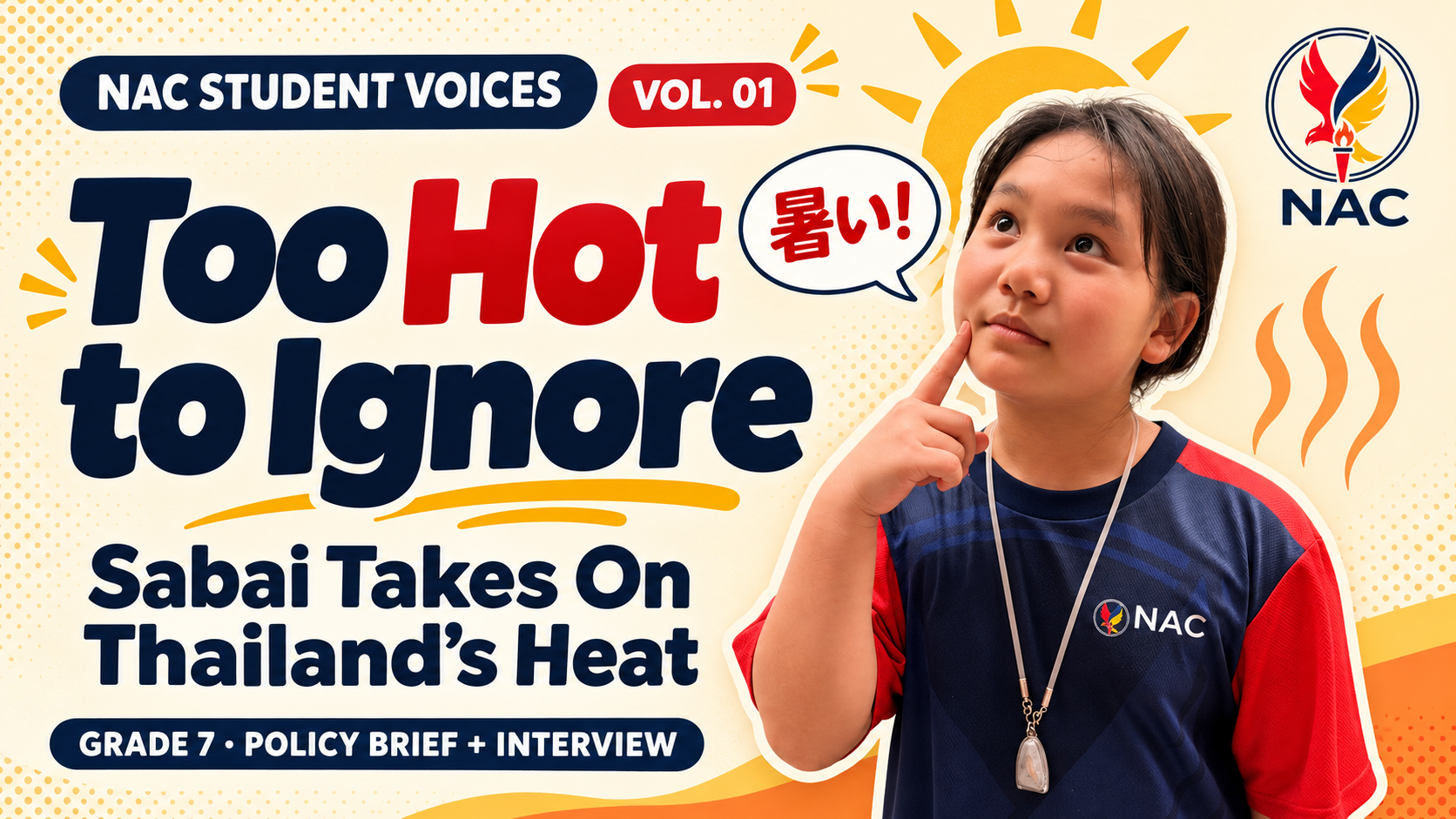
Too Hot to Ignore: Sabai Takes On Thailand's Heat
Grade 7 student Sabai wrote a policy brief to four Thai ministries about extreme heat, heat stroke, and the people most at risk. We sat down with her to talk about what she found and what she thinks should happen next.

HOTTER!
danger line
Ask anyone in Thailand about the weather and you will probably hear the same answer: hot. But Sabai, a Grade 7 student at NAC, wanted to know something deeper. How hot is too hot? Who gets hurt first? And what can the government actually do about it? Her answer became a two-page policy brief addressed to the Ministry of Labor, the Ministry of Public Health, the Ministry of Education, and the Ministry of Natural Resources and Environment. It is clear, it is serious, and it is full of ideas worth talking about.
At NAC, students learn to Lead Today, Serve Others, and Shape Tomorrow. Sabai's brief is a great example of all three: she studied a real problem, thought about the people it affects most, and proposed real solutions.
The Brief in 30 Seconds
よくわかる解説Wait, what is "apparent heat"? 🌡️
It is how hot the air actually feels to your body, not just what the thermometer says. Because Thailand is so humid, sweat can't dry and cool you down, so it feels much hotter than the real temperature.
Four Ministries, Four Fixes
ポイント
Sabai didn't just describe the problem. She gave each ministry its own job, because she believes heat is too big for one department to handle alone.
Ministry of Labor
Create new laws that shift outdoor workers' schedules so they don't work through the hottest hours of the day.
Ministry of Public Health
Improve heat warnings and teach the public to spot heat stroke symptoms early, so people know to call 1669.
Ministry of Education
Bring heat safety policies into schools and teach students how to prevent and respond to heat illness.
Natural Resources
Plant more trees and protect green spaces to cool down hot urban areas like Bangkok.
We need to take action now to make Thailand a safer and healthier place for everyone.
Sabai, from the conclusion of her briefThe Interview
インタビュー
D

D
D
D
What You Can Do Today
行動しよう!Sabai's message to other students is simple: talk about it. Heat is easy to ignore when it's "always been this way," but awareness saves lives. Here are a few ways to start, inspired by her brief:
- Know the signs. Dizziness, confusion, a pounding headache, or hot skin that stops sweating can mean heat stroke. Act fast.
- Save the number 1669. It's Thailand's ambulance and medical emergency line.
- Check the "feels like" temperature, not just the regular one, before playing or working outside.
- Look out for others. Outdoor workers, farmers, elderly people, and young children are most at risk.
- Make some noise. Create a poster, a video, or a post to help your community understand the danger.

From Research to Real Change
まとめ
finished!
Sabai built her brief using information from the World Health Organization, the World Bank, the International Labour Organization, Thailand's Ministry of Public Health and Ministry of Natural Resources and Environment, and a 2023 study on how green parks help cool Bangkok.
Policy briefs are a real-world form of writing used by governments and organizations around the world. Writing one asks students to research carefully, think about trade-offs, and explain complex ideas to decision makers. That's exactly the kind of skill NAC students build every day.
What impressed me most about Sabai's work is that she looked beyond the weather to the people behind it. She thought about outdoor workers, families, and how a new law might affect someone's daily life. That is what thoughtful leadership looks like. Congratulations, Sabai!
Dr. Allen A. Dubolino, Ph.D.
Heat stroke is a medical emergency. If someone is confused, collapses, or has hot skin and stops sweating, call 1669, move them to shade, and cool them down with water while you wait for help.
Sources cited in Sabai's brief: World Health Organization (WHO); World Bank; International Labour Organization (ILO); Ministry of Public Health, Thailand; Ministry of Natural Resources and Environment, Thailand; Patpai et al. (2023).
